Tirzepatide Vial Concentrations Explained
Compounded tirzepatide comes in 5 mg/mL, 10 mg/mL, and sometimes 2.5 mg/mL. Learn how tirzepatide concentration changes your injection volume calculation.
Quick Answer: Compounded tirzepatide is most commonly available at 5 mg/mL or 10 mg/mL concentrations. Your injection volume = prescribed dose ÷ vial concentration. A 10 mg dose requires 2.0 mL from a 5 mg/mL vial, but only 1.0 mL from a 10 mg/mL vial.
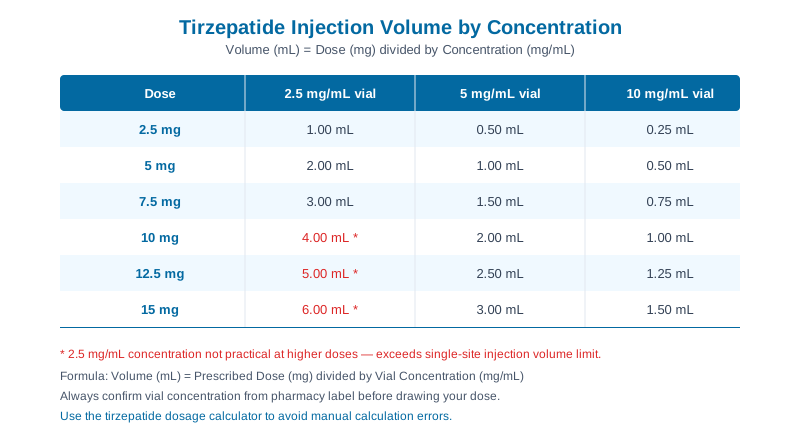
Tirzepatide concentration is one of the most practically important things to understand if you're using compounded tirzepatide. Unlike brand-name Mounjaro or Zepbound, which come as pre-measured pens, compounded vials require you to calculate and draw your own dose. Getting the concentration wrong by even a factor of 2 means you're injecting half (or double) what your prescriber intended.
What Tirzepatide Concentration Means
Concentration tells you how many milligrams of tirzepatide are dissolved in each milliliter of solution. A 5 mg/mL vial has 5 mg of tirzepatide in every milliliter. A 10 mg/mL vial has 10 mg per milliliter.
The same dose of tirzepatide looks very different in a syringe depending on concentration:
| Prescribed Dose | 2.5 mg/mL | 5 mg/mL | 10 mg/mL |
|---|---|---|---|
| 2.5 mg | 1.0 mL | 0.5 mL | 0.25 mL |
| 5 mg | 2.0 mL | 1.0 mL | 0.5 mL |
| 7.5 mg | 3.0 mL | 1.5 mL | 0.75 mL |
| 10 mg | 4.0 mL | 2.0 mL | 1.0 mL |
| 12.5 mg | 5.0 mL | 2.5 mL | 1.25 mL |
| 15 mg | 6.0 mL | 3.0 mL | 1.5 mL |
Notice that a 2.5 mg/mL vial requires very large volumes at higher doses (6.0 mL for 15 mg is not practical for a subcutaneous injection). This is why 2.5 mg/mL vials are mostly used for the starting dose phase and 10 mg/mL becomes the standard at higher doses.
The Three Common Concentrations
2.5 mg/mL
Uncommon but sometimes dispensed for the initial 2.5 mg phase. At 2.5 mg/mL, your 2.5 mg starting dose = 1.0 mL, which is easy to measure. The problem is scalability: you can't use this concentration at 10 mg or 15 mg without injecting 4–6 mL, which exceeds the practical limit for a single subcutaneous injection.
If your pharmacy gave you a 2.5 mg/mL vial and you're escalating beyond 5 mg, contact them about switching concentrations.
5 mg/mL
The most widely dispensed concentration for patients across all dose phases. Volumes stay practical: 1.0 mL at 5 mg and 2.0 mL at 10 mg. Most 1 mL insulin syringes handle up to 2.0 mL if you use two syringes or a 3 mL syringe at higher doses.
At 15 mg from a 5 mg/mL vial, you'd inject 3.0 mL. This is typically split into two injection sites (1.5 mL each) to avoid injecting more than 2 mL at a single site.
10 mg/mL
Higher concentration means smaller volumes, which is more comfortable for injections and practical for higher doses. At 15 mg, you're drawing only 1.5 mL in a single comfortable injection.
The tradeoff: errors in measurement are more consequential. A 0.1 mL error at 10 mg/mL = 1 mg dose error. The same 0.1 mL error at 5 mg/mL = 0.5 mg dose error. Use the tirzepatide dosage calculator before every dose draw to confirm exact volumes.
The Dose Calculation Formula
Volume (mL) = Dose (mg) ÷ Concentration (mg/mL)
This is the only formula you need. It never changes regardless of which concentration your pharmacy uses.
Examples:
- 7.5 mg dose, 5 mg/mL vial: 7.5 ÷ 5 = 1.5 mL
- 7.5 mg dose, 10 mg/mL vial: 7.5 ÷ 10 = 0.75 mL
- 12.5 mg dose, 10 mg/mL vial: 12.5 ÷ 10 = 1.25 mL
The volume calculator tool does this instantly: enter your dose and concentration and get your volume. No mental arithmetic required before each injection.
How to Confirm Your Vial's Concentration
This should be done before drawing from any new vial, and especially when switching pharmacies or when your refill looks different from the last batch.
- Read the vial label directly. The concentration must be printed on the label, e.g., "Tirzepatide 10 mg/mL." If it isn't, call your pharmacy before injecting.
- Check the total volume and total dose. Many vials list total content: "Tirzepatide 50 mg / 5 mL" means 10 mg/mL. "Tirzepatide 30 mg / 6 mL" means 5 mg/mL.
- Ask for the Certificate of Analysis (COA). Reputable compounding pharmacies provide a COA showing the actual tested concentration of each batch. This is especially important for 503A pharmacies.
- Call before injecting if you're unsure. If the label is unclear, the concentration differs from what you expected, or you've switched pharmacies, call your pharmacy. A 5-minute call is worth it.
Why Pharmacies Use Different Concentrations
Compounding pharmacies choose concentrations based on:
- Patient dose range: Higher-dose patients need higher concentration vials for practical volumes
- Stability data: Higher concentrations may have different stability profiles; some pharmacies have stability data for 10 mg/mL, others only for 5 mg/mL
- Vial size: A 10 mL vial at 5 mg/mL holds 50 mg total. The same vial at 10 mg/mL holds 100 mg, meaning more doses per vial, which may reduce cost
There's no universal standard. This is why you cannot assume your new pharmacy's vial matches your previous one.
Switching Concentrations Mid-Treatment
If you switch pharmacies and receive a different concentration than you're used to, recalculate your volume before every injection going forward. This is the most common source of dosing errors in compounded tirzepatide patients.
A patient previously drawing 1.0 mL (5 mg from a 5 mg/mL vial) who receives a 10 mg/mL vial and draws 1.0 mL by habit is now getting 10 mg, double the intended dose. This is a real clinical scenario that causes avoidable side effects and potential harm.
Bookmark the injection volume calculator so it's always accessible when you open a new vial.
Units vs. Milliliters on Insulin Syringes
Standard U-100 insulin syringes are marked in units (where 100 units = 1 mL). This causes confusion when pharmacies or prescriptions express doses in mL.
The conversion: 1 mL = 100 units on a U-100 syringe.
So 0.75 mL = 75 units. 1.5 mL = 150 units (requiring a 2 mL syringe, since standard insulin syringes max at 100 units / 1 mL).
At higher doses from 5 mg/mL vials, you'll need a 3 mL syringe rather than a standard insulin syringe. Your pharmacy should supply appropriate syringes, or advise you on size.
For the full injection process from vial to site, see the step-by-step tirzepatide injection guide. For context on why compounded tirzepatide has different concentrations than brand Mounjaro, see compounded tirzepatide vs Mounjaro.
The about page has more information on how this site approaches clinical accuracy.
Ready to calculate your dose?
Free tirzepatide injection volume calculator. No signup required.