Tirzepatide Dosage Schedule: Week-by-Week Guide
Follow the full tirzepatide dosage schedule from 2.5 mg to 15 mg. Learn what to expect at each phase and how to handle dose escalation.
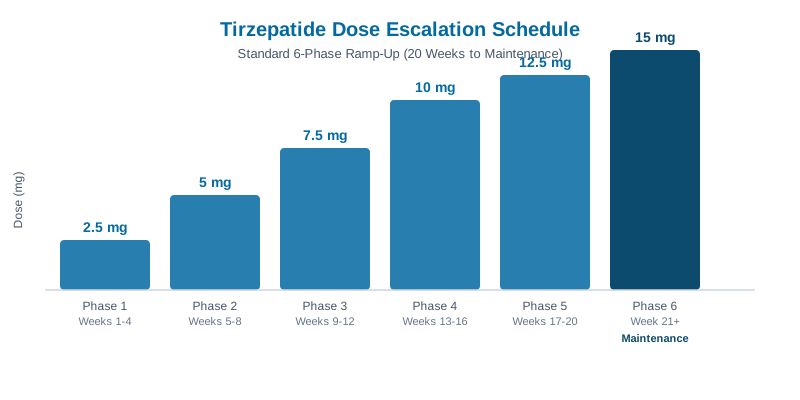
Quick Answer: The standard tirzepatide dosage schedule starts at 2.5 mg weekly and increases by 2.5 mg every 4 weeks, reaching a maximum of 15 mg over about 20 weeks.
The tirzepatide dosage schedule is one of the most frequently misunderstood parts of starting this medication. Patients often wonder why they're on such a low starting dose, or why they can't jump straight to 10 mg if their friend is already there. The answer is simple: your GI tract needs time to adapt.
Here's the complete roadmap, phase by phase.
The Full Tirzepatide Dosage Schedule
There are six dose phases. Each lasts a minimum of 4 weeks. Your prescriber may hold you at any phase longer if needed. That's completely normal and not a failure.
| Phase | Dose | Weeks |
|---|---|---|
| 1 | 2.5 mg | Weeks 1–4 |
| 2 | 5 mg | Weeks 5–8 |
| 3 | 7.5 mg | Weeks 9–12 |
| 4 | 10 mg | Weeks 13–16 |
| 5 | 12.5 mg | Weeks 17–20 |
| 6 | 15 mg | Week 21+ |
Not everyone needs to reach 15 mg. The SURMOUNT-1 trial (published in the New England Journal of Medicine) showed significant weight loss at all maintenance doses (10 mg, 12.5 mg, and 15 mg), with higher doses generally producing greater results. Your prescriber will work with you to find the dose that gives you good results with tolerable side effects.
Phase 1: 2.5 mg (Weeks 1–4)
The starting dose of 2.5 mg is sub-therapeutic for weight loss. It's not meant to produce results yet; it's designed to introduce the medication to your system gently.
Most people feel very little at this stage. You might notice mild nausea after your first 1-2 injections, or slightly reduced appetite. Don't be discouraged if the scale doesn't move much in week 1. This phase is about tolerance-building, not results.
Use the first 4 weeks to establish your injection routine: same day each week, same time of day, rotating sites between abdomen, thigh, and upper arm.
Phase 2: 5 mg (Weeks 5–8)
At 5 mg, most patients start noticing real appetite suppression. Food feels less interesting. You may feel full after eating about 60-70% of what you'd normally eat. This is the GLP-1/GIP dual mechanism working as intended.
Side effects often peak here. Nausea is most common in weeks 5-6 of this phase, especially if you eat large meals or high-fat foods. Small, frequent meals (4-5 per day at 300-400 calories each) work better than 3 large ones.
Some weight loss usually begins in this phase. Expect 1-2 lbs per week on average if you're also adjusting your diet.
Phase 3: 7.5 mg (Weeks 9–12)
The 7.5 mg dose is where many patients hit their first real "wow" moment. Appetite suppression becomes more consistent throughout the week, not just for 2-3 days after injection.
GI side effects (nausea, loose stools, constipation) may resurface briefly as you adjust to the higher dose. This typically settles within 7-10 days.
Some patients experience fatigue or low energy at this phase. Make sure you're eating enough (1,200-1,500 calories minimum for most adults), because under-eating on tirzepatide is a real risk.
Phase 4: 10 mg (Weeks 13–16)
At 10 mg, you've passed the midpoint of the escalation ladder. The SURMOUNT-1 trial showed that patients on 10 mg lost an average of 19.5% of body weight at 72 weeks. That's meaningful data.
Many patients choose to stay at 10 mg long-term rather than escalating further, especially if side effects become difficult to manage. There's no medal for reaching 15 mg. The right dose is the one you can take consistently.
Use the tirzepatide dosage calculator to verify your injection volume at this dose, especially if you're using a compounded vial with a specific concentration.
Phase 5: 12.5 mg (Weeks 17–20)
This phase and the next are for patients who haven't reached their target weight or A1C on 10 mg. The incremental benefit in the SURMOUNT-1 data between 10 mg, 12.5 mg, and 15 mg is measurable but not dramatic for everyone.
Side effects at this level can be more persistent. If you're finding this dose difficult, talk to your prescriber about staying at 10 mg. Dose reduction or holding is a legitimate clinical decision, not a setback.
Phase 6: 15 mg (Week 21+)
The 15 mg dose is the maximum approved dose for both Mounjaro (diabetes) and Zepbound (weight management). In SURMOUNT-1, 15 mg produced the highest average weight loss: 22.5% of body weight at 72 weeks.
At maintenance, you'll stay at whatever dose your prescriber determines is your therapeutic sweet spot. Some patients maintain on 5 mg; others need 15 mg. This is highly individual.
What If You Can't Tolerate a Higher Dose?
This is common and manageable. If escalating to the next dose causes intolerable nausea, vomiting, or GI distress, you have options:
- Stay at the current dose for another 4 weeks before trying to escalate again
- Ask your prescriber about a modified escalation. Some protocols use 8-week holds between doses
- Adjust your injection timing. Some patients tolerate evening injections better because they sleep through the worst nausea
- Review diet habits. Fatty, spicy, or large meals dramatically worsen GI side effects
The complete injection volume calculator is especially useful when you're switching doses and need to confirm exactly how many units to draw. Concentration matters a lot here: 2.5 mg at a 5 mg/mL concentration is 0.5 mL, but the same dose at 10 mg/mL is only 0.25 mL.
Never skip doses to manage side effects without talking to your prescriber first. Missed doses and how to handle them are covered in the guide to what to do when you miss a tirzepatide dose.
Tirzepatide Dosage Schedule for Type 2 Diabetes vs. Weight Loss
The escalation schedule is identical for both indications. Mounjaro (type 2 diabetes) and Zepbound (chronic weight management) use the same 2.5 mg → 15 mg ladder. The difference is in who prescribes it and what insurance covers.
For diabetes patients, your A1C response may also guide how quickly your prescriber wants to escalate. For weight loss patients, the focus is more on tolerability and weight trajectory.
Tracking Your Schedule
Keep a simple log: date injected, dose, any side effects, weight (weekly or bi-weekly). This takes 2 minutes per week and becomes invaluable at your follow-up appointments.
If you lose track of where you are in the schedule, or if you've had a few missed weeks and aren't sure what dose to restart at, see the advice on handling a missed tirzepatide dose or check with your prescriber before self-adjusting.
Understanding your tirzepatide dosage schedule is the foundation for getting the most out of this medication. The gradual escalation isn't bureaucracy; it's clinical design. The pharmacology works better when your body adapts to each level before moving to the next.
For help calculating the exact volume to inject at any dose, visit the dose and volume calculator tool.
Ready to calculate your dose?
Free tirzepatide injection volume calculator. No signup required.